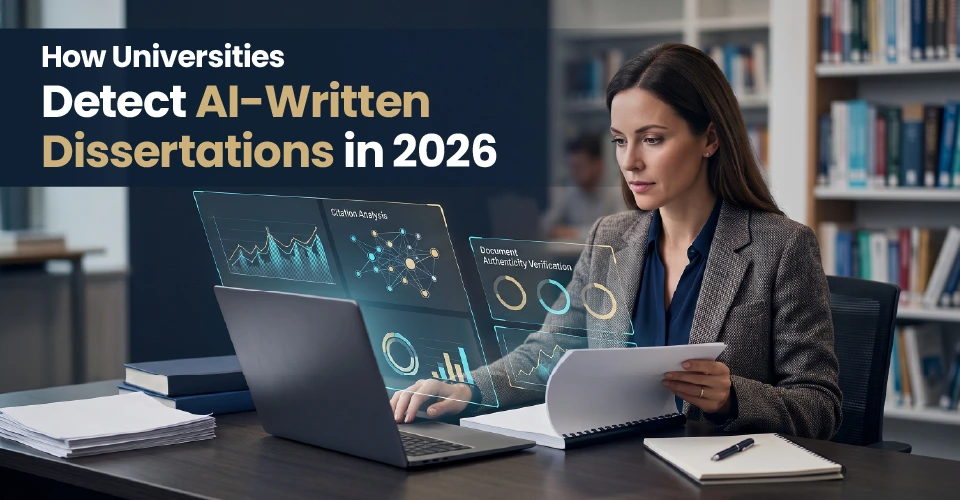
How Universities Detect AI-Written Dissertations in 2026
Generative AI tools such as ChatGPT, Claude and Gemini are ushering in a new age of academic writing, and a new battle is unfolding between UK universities and the emerging AI submissions. In 2026, the vast majority of schools will view it as cheating to use AI-generated content as someone's own writing and will take action, ranging from failing the module to expulsion. However, the detection methods are not foolproof and have improved over the years.
This guide addresses how universities detect AI-written dissertations, how they can use tools, how universities can use methods, and when and where to find signs that would alert them to an AI-generated dissertation. Before diving deep, review the pros and cons of AI for dissertation writing. In the new landscape of the academic world, where AI dissertation detection 2026 is on the rise, all students must be aware of this process.
Why Universities Are Taking AI Detection More Seriously in 2026
The rapid adoption of generative AI has led to UK universities having to respond since 2023. Today, 90 percent of students are using AI for at least some purpose, QAA asserts. In 2023, JISC carried out a survey which found that significant numbers of students in the UK were using AI to complete assessed students' work. Universities, in turn, lobbied and were given improved detection tools.
The Quality Assurance Agency for Higher Education (QAA) released new guidance on the use of AI and academic integrity in 2024–2025, and most institutions now have guidelines regarding the misuse of AI. Once the ‘grey zone' is now the ‘misconduct zone'.
University AI academic integrity policy UK is an initiative of the university, and each university develops and adopts its own policy. This means that students need to be aware of how universities detect AI writing. To find out how to interact with a professional writer ethically, consult the guidelines: how to work with a dissertation writer without breaking university rules.
AI Detection Software — The Tools Universities Use
By 2026, UK universities will use various types of AI detection technologies, each with its own strengths and weaknesses.
-
Turnitin AI Detection
Most universities in the UK now have their normal submission process include their AI Detection function from Turnitin. It produces an AI percentage score in addition to the plagiarism score and classifies text as 'likely AI-generated' using probabilistic language models. Turnitin states that it has a false-positive rate of less than 1% for plagiarized work containing more than 20% AI-generated writing.
This accuracy is much lower than that, though. It provides an estimate of the percentage of text that it thinks is likely to be created or paraphrased by AI, with the estimate being 98% or higher. One of the primary tools is Turnitin AI detection dissertation, but it doesn't indicate which one it's from, ChatGPT, Claude, or Gemini.
-
Copyleaks AI Detector
Some UK institutions are using Copyleaks as a second line of detection. It compares the text pattern with existing AI-generated text, providing an additional layer of validation.
-
GPTZero
GPTZero is a widely used application among faculty for one-on-one text grading. Compares perplexity and burstiness scores, which are important measures in linguistics when determining patterns in AI-generated text.
-
Unicheck and iThenticate
These are generally used at the Master's or PhD to analyse longer academic texts or papers.
There are no tools that are 100% correct. False Positives exist. Universities are increasingly adopting these as a red flag for AI detection tools for dissertations UK. These are used as red flags in the UK and not as a judgment at universities. This is indicative of the larger trend of AI dissertation detection 2026.
Linguistic and Stylistic Analysis — Beyond the Software
It may seem surprising, but it isn't hard to detect AI-written text even without the software. They search for stylistic and linguistic indications of synthetic sources:
Uniformly polished prose: AI-generated sentences are less varied in quality than human text. No uneven transitions, awkward phrases, or rough spots.
Generic phrasing: AI uses overly vague words: “it is important to note that,” “furthermore,” “in conclusion.” They are formulaic phrases and are not as specific as real academic writing.
Structural predictability: AI-created dissertations may follow a rigid format similar to a template. Academic writing is a natural progression and sometimes an offshoot!
Absence of personal voice: AI writing doesn't have any development of argument, and doesn't have the idiosyncrasies of the discipline. It is almost like it's a non-person written piece.
Wrong or hallucinated citations: AI produces wrong or hallucinated citations. Can universities detect ChatGPT in dissertations? There's nothing that really suggests a fake citation more than that.
Tonal inconsistency: Supervisors know if a student's prior work, emails, or seminar presentations are of a different level from that of the dissertation. This is one way how universities detect AI writing in practice.
Viva Voce and Oral Examinations as Detection Methods
Viva voce exams are implemented by many universities in the UK, especially at post-graduate and PhD levels, in part for the use of AI detection. When a student is unable to provide the most basic answers to questions about the dissertation itself, red flags are set:
- Their methodology choices
- Their primary means of communication.
- Their analytical reasoning
- Choosing the arguments in certain chapters
May lead to a formal complaint of misconduct. Recognizing the concerns raised by AI, some universities have seen a revival in providing oral exams for undergraduate students or have started to provide more. This human-centred approach complements the AI detection tools for dissertations UK, and it doesn't make the entire process of how universities detect AI-written dissertations software-based.
Several students resort to the services of expert writers from buy dissertation UK if they are certain that they need extra support when preparing for the viva or merely know how to make their dissertation subject more comprehensible.
How Accurate Is AI Detection — And What About False Positives?
AI detection tools are not foolproof. There have been many instances of false positives: students with a high grade in academic language have been incorrectly identified, especially non-native English speakers. Stanford, Cambridge, and Oxford scientists have said they are very skeptical of the detection.
Academic and high-stakes environments are "poorly suited" for the use of AI-generated text detectors that are readily available in the market, according to research presented at the 2026 IEEE Symposium on Security and Privacy.
Turnitin states that its system was not designed to be the only evidence of wrongdoing. These are recognised by the UK universities. Although most do not use AI detection as a stand-alone measure of academic dishonesty, it is a part of an academic honesty investigation.
When a student is assigned a Turnitin AI detection dissertation score, it could lead to a review, followed by a fair process that must include the opportunity for the student to respond. The procedures with regard to fair academic practice and the QAA and the Office for Students are outlined.
Students should be aware of their rights and the capabilities of AI writing detection accuracy UK universities by knowing the accuracy rate. When asked, ‘Can universities detect ChatGPT in dissertations? ', the answer is ‘sometimes ' but not reliably enough for it to be the only proof.
What Happens If a University Suspects AI Use?
The typical academic misconduct procedure at UK universities is as follows:
- By detection software or a supervisor.
- Case referred: The case will be brought to the attention of the academic integrity officer.
- Student notified = invited to respond, typically in writing.
- An oral examination or oral interview can be requested to confirm comprehension.
- Panel review: of all evidence.
- Consequences/penalties: warning, diminished grade, failure of the module, submission of a rewritten assignment, and, in severe instances, expulsion.
Institutions vary with regard to severity and outcomes. Students have the option to appeal and submit their own drafts, notes, research materials, version histories, etc. Each institution will have specific procedures and penalties as outlined in the university AI academic integrity policy UK. Students can find out how universities detect AI-written dissertations and can avoid this scenario.
What This Means for Students Who Need Support
There are options available for dissertation writing that do not pose a risk to students who have difficulties. These include:
- Free and confidential writing centre help is available at the University.
- Advice on the dissertation from dissertation supervisors and personal tutors.
- Professional academic support services those that offer model answers and guided learning, NOT AI-generated text that is submitted directly.
A professionally written dissertation help that is used as a reference and learning material is not the same as a self-generated AI, in which the student is not intellectually involved. This is a safer and sounder alternative to unverified AI tools.
Understanding AI dissertation detection 2026 and how to avoid AI detection in a dissertation implies making an ethical decision to secure genuine learning and understanding in the face of the threat of academic dishonesty. Yeah, check out professional dissertation writing services in the UK to learn more about the services.
Conclusion
By 2026, AI detection of dissertations will be automated with a multi-layered approach using software programs, linguistic analysis, supervisor evaluation, and oral examinations. Not every detection method is perfect, but it is a threat, and it's growing. The prevalence of AI tools like Turnitin and the use of AI in student life has increased to about 90%, making students aware of how universities detect AI-written dissertations when making informed decisions about their academic work. Our dissertation writing services are a perfect choice when you need to have experts who will let you be in control of your academic life.